

The Greatest Olympic Athlete You’ve Never Heard Of
Why the Olympic Games are the media’s most powerful discovery engine.


Welcome to Hub Intel. We’re here to provide data, not drama. Our goal is to help you understand the trends in the entertainment industry and what they mean to your business.
The Greatest Olympic Athlete You’ve Never Heard Of
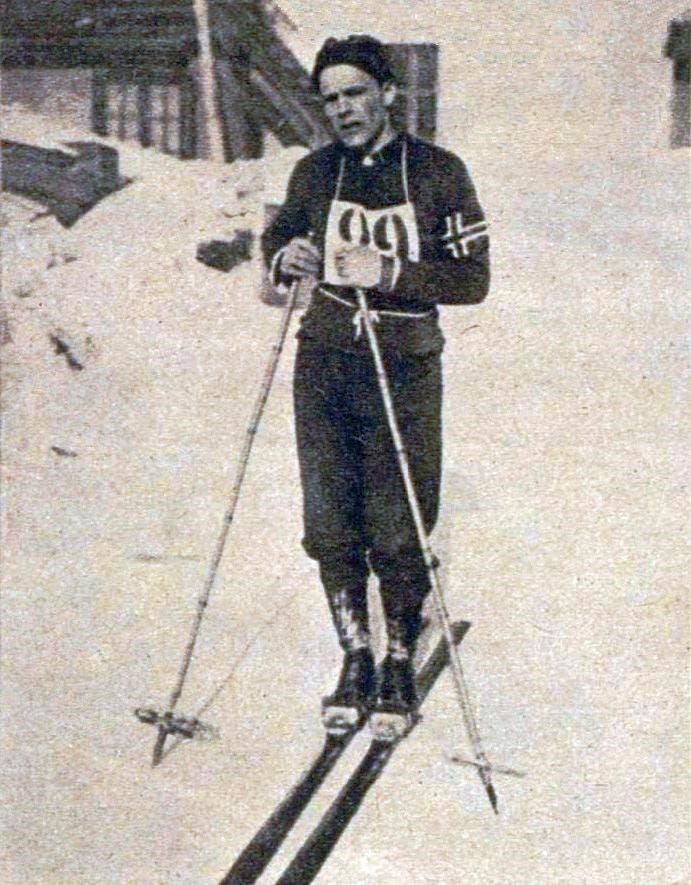
He stood at the start of the race and tried to slow his breathing. Ahead of him, he saw nothing but white snow and a crowd that felt enormous. The gold medal was on the line. Strong, steady, and composed, with the chiseled cheekbones of a Viking god that would make every marketer (and even the mountains behind him) hold their breath in awe, he readied himself. All it would take was this run, and he would not just win, but he would arrive.
Arrival. What a word. Winter Olympic history. National pride. World fame. Yes, all of that … and more. Arriving on the world stage would mean slow-motion replays across every streaming platform. Split-screen reaction shots of cheering family and proud coaches. Sponsorship offers waiting in his DMs. An energy drink ambassadorship. A podcast tour. A winter apparel capsule collection. An entire global following built before he even crossed the finish line. No pressure. All it would take is one good run.
Except Thorleif Haug had one very big problem: the date. The year was 1924. There were no global broadcast rights. No primetime medal ceremonies. No replay packages. No highlight clips. No second screen. No algorithmic amplification. No monetizable social media velocity.
That week in Chamonix, France, Haug won three gold medals at the very first Winter Olympics in 1924. He dominated Nordic combined and cross-country skiing. For his era, he was an Olympic GOAT.
But where did his accolades lead him? They led him to become … a plumber. That’s right. He died at 40 in his hometown. His recognition was local, and his fame (like his sport) was bound by the infrastructure of the times.
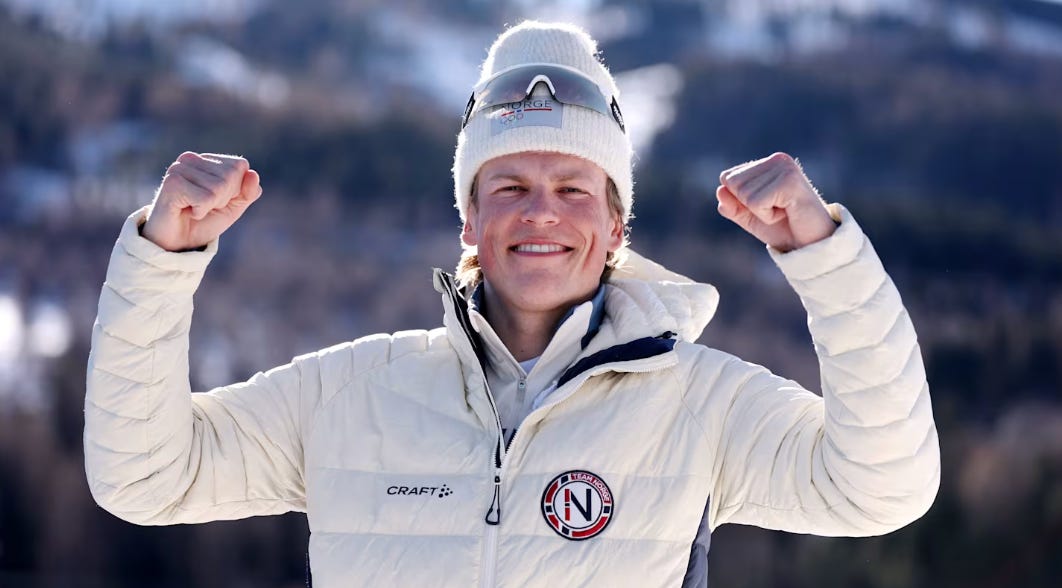
A century later, another athlete stands at the starting line in Milan-Cortina. He too is focused, knowing his stats will populate dashboards in Los Angeles and London within seconds. His face will circulate in markets that cannot define cross-country skiing. His name, Johannes Høsflot Klæbo, will become searchable before he reaches the finish line. And he will win all the cross-country skiing events. Yes. All of them, collecting six gold medals for Team Norway. He will be the new cross-country ski GOAT.
In the course of a hundred years, the skis have improved. The training has evolved. The data is richer. But the most profound transformation is the infrastructure of transmission and distribution of information. The Games may last a mere 17 days, but today their footprint spans hundreds of millions of viewers and billions of minutes consumed.
For the Milan-Cortina Olympics, NBCUniversal reported reaching blockbuster U.S. audiences of more than 50 million viewers each day, continuing the media dominance it experienced less than two years ago at the Paris Olympics. A clear reminder that even in a fragmented media landscape, the Games remain one of the few events capable of true mass consumption. And that is the real story here.
The Olympics have the power to rewrite media discovery at scale.
The Power of Unknown Athletes
We all know that star athletes drive consumption. That is not revolutionary. Put a recognizable name on a marquee matchup, and audiences show up. If you haven’t heard of Lindsey Vonn, you’ve probably been living under a rock.
But for anyone who thinks the Olympics are only about celebrity athletes, I have news. Every four years, it is not just the global celebrities who matter. It is the unknown athletes who become unavoidable almost overnight. Johannes Høsflot Klæbo, someone you had never heard of at breakfast, was the name on everyone’s lips by dinner.
During the Olympics, viewer attention gravitates toward breakout athletes, and that attention speaks directly to viewer motivation. According to Hub’s Evolution of Sports Wave 2 people watch the Olympics for a wide variety of reasons.
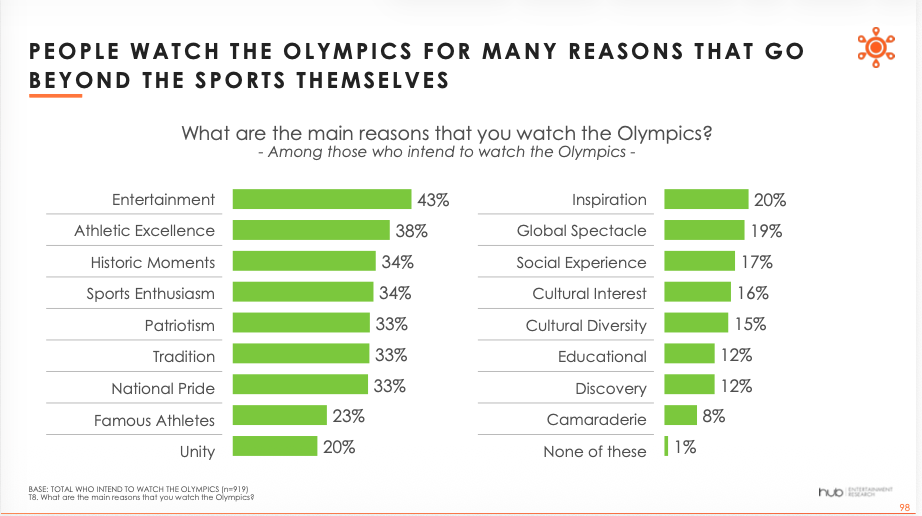
And while 43% of Olympics viewers enjoy the pure entertainment of the Games, 38% of viewers watch the Olympics to see athletic excellence. In other words, they tune in to celebrate athleticism, not just to see a celebrity athlete.

In a fragmented landscape ruled by algorithms, the Olympics remain one of the most efficient large-scale athlete discovery engines in entertainment. And that variety also speaks to the unique nature of Olympic fandom.
The Power of Discovery Over Loyalty
You’d be forgiven if you assumed that consumption is driven by diehard Olympic superfans. Figure skating and hockey have a loyal fan base. And while superfans exist, they are not the only fans watching. The Olympics operate differently, assembling a broad coalition of viewers. Even casual sports fans behave differently during the Games. In fact, according to Hub Research, casual sports fans are nearly twice as likely to watch the Olympics on TV as they are to watch live sports in general.
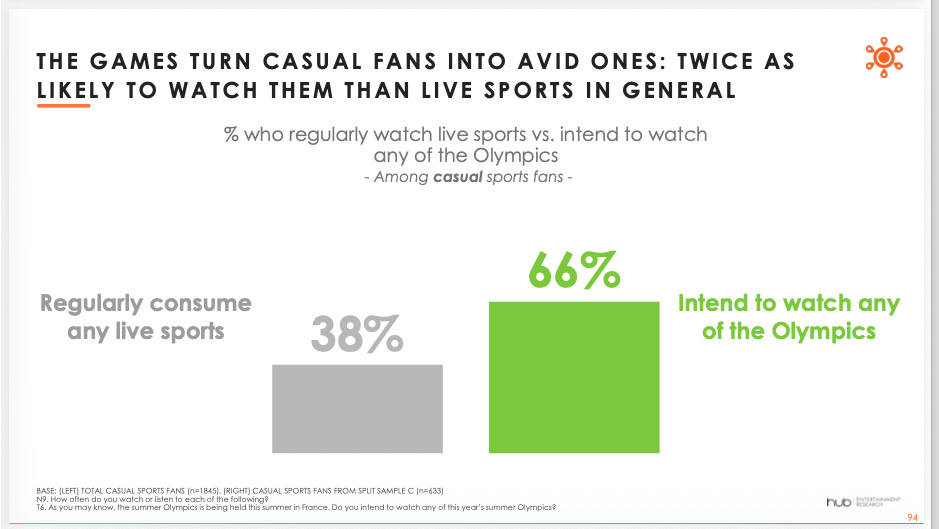
So how do the Olympics turn casual fans into avid ones? Olympic fandom is less about sports loyalty behavior and far more about sports discovery behavior. The Games introduce volatility that goes far beyond the athletes themselves, with unusual equipment, cinematic global stages, semi-obscure sports, unique competition settings, unfamiliar rules, and strange terminology — all layered with national pride.

Where normally you’d see diversity in viewing behaviors as unique audience segments, and call them superfans, the Olympics create a sort of pop-up shop of curiosity with a developing surge of fandom. You might not know why you’re excited, but when you catch the Olympic spirit, you’re not just a superfan, you’re a surgefan.

Olympic surgefans bring fewer expectations, making it easier for their interest to merge into a shared, real-time viewing moment. Their loyalty isn’t to one sport, but to the cultural experience of the Games themselves.
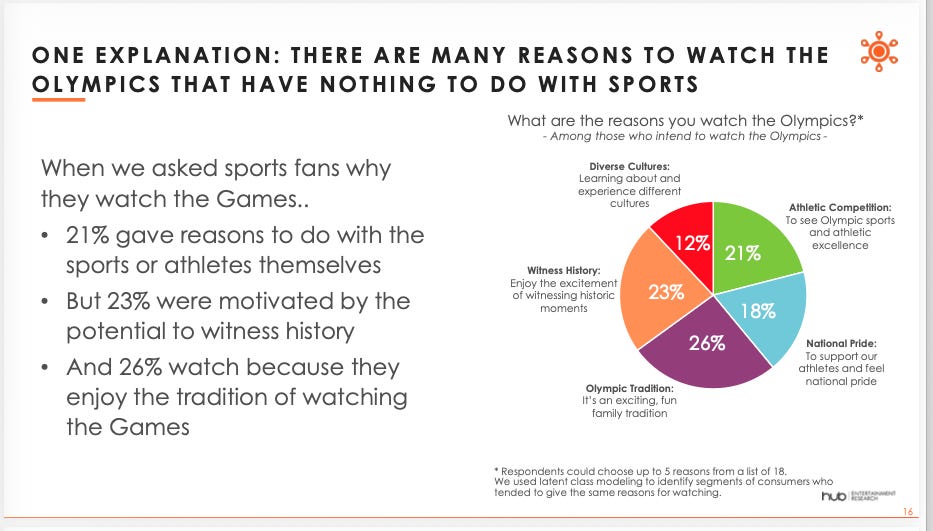
According to Hub research, 12% of viewers watch for cultural curiosity, 18% to support their country or countries of their ancestral heritage, and another 23% tune in to experience history and the emotional intensity of Olympic moments. Of those surveyed, 26% describe the Games as “an exciting family tradition.”

Professional leagues like the NFL, NHL, MLB, and NBA are built on familiarity. Fans know the teams, the star players, and the storylines that develop over multiple seasons. They often watch to see those expectations confirmed — to see their team win, their stars perform, and the rankings hold true. The Olympics work differently. Most viewers don’t come in with strong loyalties. Instead, they form new attachments as the events unfold. Rather than following a long-running story, Olympic viewers are drawn into a shared moment of excitement, where discovering new athletes and unexpected outcomes is part of the appeal.
The Power of the Consumption Shockwave
The Olympic Games take place over just two weeks, and that short window concentrates a huge amount of viewing. During the Beijing Games, NBCUniversal reported 4.3 billion streaming minutes across its digital platforms. For Milan-Cortina, that number rose to 16.7 billion minutes — more than double all previous Winter Olympics combined (6.9 billion minutes) — with Peacock streaming more than 850 live events over 17 days. Viewers didn’t just watch casually; they watched extensively, following events across multiple devices and screens at the same time.

For 17 days, audience segments that normally watch different things come together and watch the same events at the same time. Casual viewers, hardcore sports fans, cultural observers, national supporters, and social-media-driven audiences all converge. That convergence creates intensity at scale. Most modern media is built to reduce risk and reward predictability. Franchises keep audiences engaged across seasons. Serialized universes spread risk over time. Familiar intellectual property and established stars help stabilize demand. But the Olympics operate differently.
The Games compress uncertainty into a short, global window. No one knows exactly what will happen. The heroes aren’t predetermined. The competitive order can change in real time. And when an athlete, team, or performance breaks through, recognition doesn’t spread slowly — it explodes all at once.
Search interest spikes. Follower counts surge. Clips spread rapidly. Sponsorship value rises. Analytics dashboards light up everywhere at the same time. It creates a rare concentration of full-scale attention density. It creates a shockwave that can consume so much domestic bandwidth that the internet could tip over. Literally.
The Power of Unpredictability
In an industry built to avoid uncertainty, the Olympics show that unpredictability can draw huge attention across platforms and audiences all at the same time.
“These Olympics captured everyone’s imagination in ways no one could have predicted. The settings were stunningly beautiful, providing a spectacular backdrop for the intense competition. The technology — including enhanced audio and drones — coupled with the unprecedented access we had to athletes and their lives allowed us to take the audience inside their stories in fresh, meaningful ways,” — Molly Solomon, Executive Producer & President of NBC Olympics Production.

In a media ecosystem obsessed with controlling outcomes, the Olympics succeeds by refusing to. It gathers the unknowns. The athletes, the sports, the expectations, and the results, wraps them up in a puffer jacket, and puts them on the world’s biggest stage, letting the performance decide the outcome.
In a global media industry shaped by distribution technology and risk avoidance, the Olympics still bets on the unknown to create discovery at scale. That takes guts. A century ago, Thorleif Haug won three gold medals and remained largely unknown, not because he lacked talent, but because the world lacked the ability to amplify him. Today, the world is fully connected, and the stakes are far higher. Yet while modern media prioritizes safety, stability, franchises, and loyal audiences, the Olympics still bets on surprise. And that is why it still matters.
SJ McKenzie is a former Product Design executive at NBCUniversal and NBC Sports & Olympics and a two-time Emmy Award winner whose work helped bring the world’s greatest sports stories to screens of all sizes, including The Olympic Games, The Super Bowl, The World Cup, Formula 1, Le Tour de France and more. A former world-ranked tennis player, she has spent more than two decades at the intersection of sport, media, and technology, shaping digital experiences across broadcast and streaming platforms. As a designer, writer, and creative director, McKenzie holds multiple technology patents and focuses on audience behavior, storytelling, and the evolving relationship between humans and media. Her work explores how narrative, design, and emerging technologies shape collective experience and cultural connection.
Going to This Conference? Come Say Hi 👋🏼
StreamTV Europe: April 13-15, 2026 (Lisbon, Portugal)
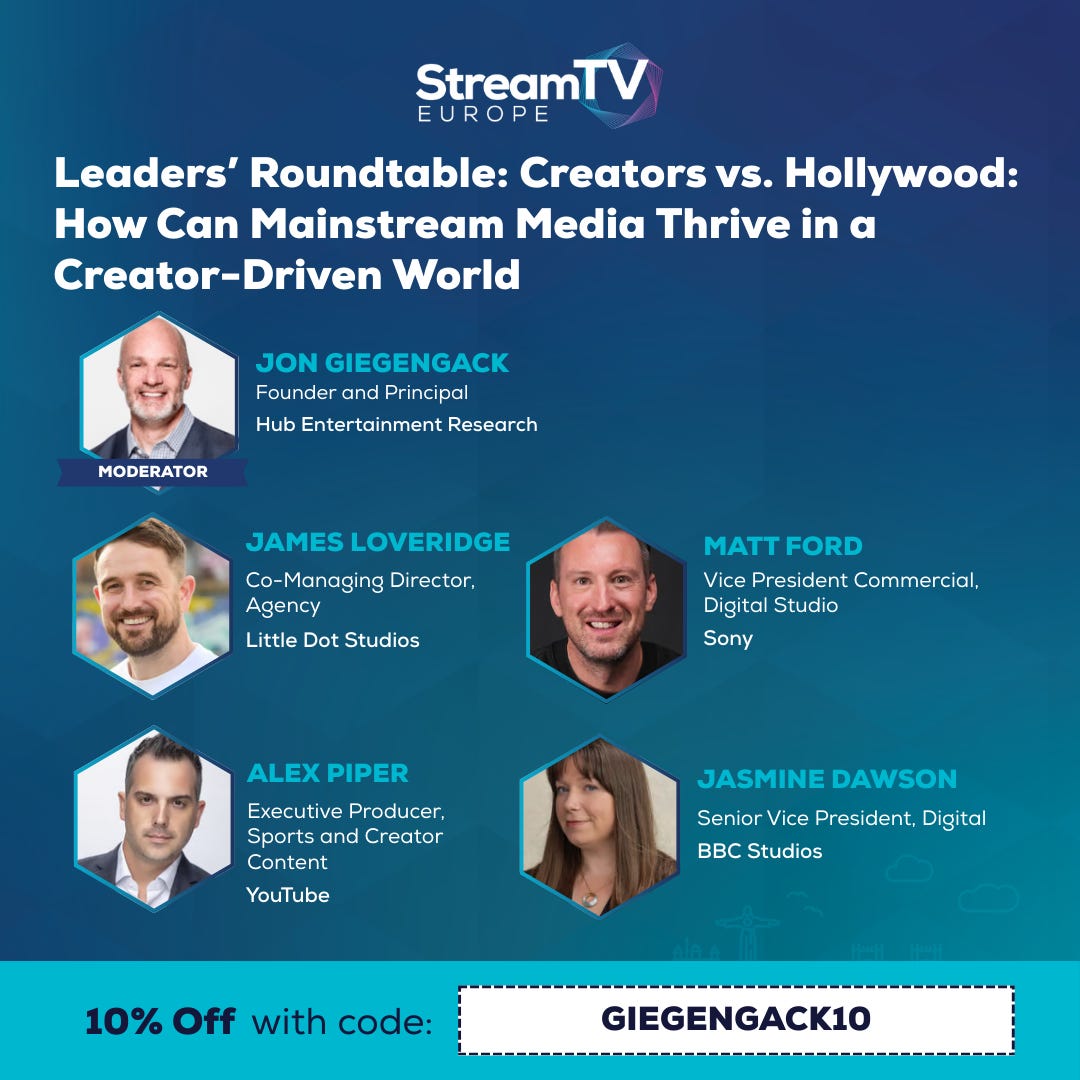
Leaders’ Roundtable: Content Gets Personal: Prestige Production vs. Creator Connection
Wednesday, April 15 — 11:40am - 12:10pm (GMT)
For a century, Hollywood’s business model has been “premium” content: a level of storytelling and production that could not happen anywhere else. Today, audiences increasingly assign that label based on connection, relevance, and engagement: things associated with creator-driven content than traditional TV. This panel will share new research among audiences in the US and Europe about what makes content valuable, a vibrant discussion on the new definition of “premium” content, and ideas for legacy media companies to adapt and thrive at the intersection of mainstream and creator content.
Want More Hub Intel?
Hub Intel is a reader-supported publication. Become a paid subscriber to get access to exclusive Hub research on key topics as well as admission to Hub’s webinars.
Hub Entertainment Research tracks how technology is changing the way people find, choose, and consume entertainment content: from TV and movies, to gaming, music, podcasts and social video. Working with the largest networks, pay TV operators, streaming providers, and studios, Hub’s studies have covered the most important trends in providers, devices, and technologies since 2013.
Learn More: Visit our website
Follow Us: LinkedIn
Get In Touch: Email us at hubintel@substack.com